
Hamilton Character Guide
Aaron Burr
Aaron Burr is the man who will eventually kill Alexander Hamilton in a duel, and from the first moment he appears on stage, he is already moving toward that end without knowing it. He is cautious where Hamilton is reckless, calculating where Hamilton is impulsive, and he watches the world with a patience that reads as wisdom until it starts to read as cowardice. He and Hamilton are friends, rivals, and finally enemies, and the tragedy is that Burr understands Hamilton better than almost anyone else, which makes the duel inevitable.
Personality for Dance
Burr holds himself in. His posture is controlled and deliberate, shoulders down, weight balanced, hands quiet at his sides or clasped in front of him. He watches before he speaks and he moves only when he has decided where he is going. He stands at the edges of group scenes, observing, and his stillness becomes magnetic because the audience senses that there is something contained inside it. Wait for It is the moment where that containment finally cracks, and the movement should feel like watching someone hold something back for so long that they cannot hold it anymore. His contemporary training shows in the precision and the specificity of his physical vocabulary. Nothing is casual. Everything means something.
The Outfit
Top
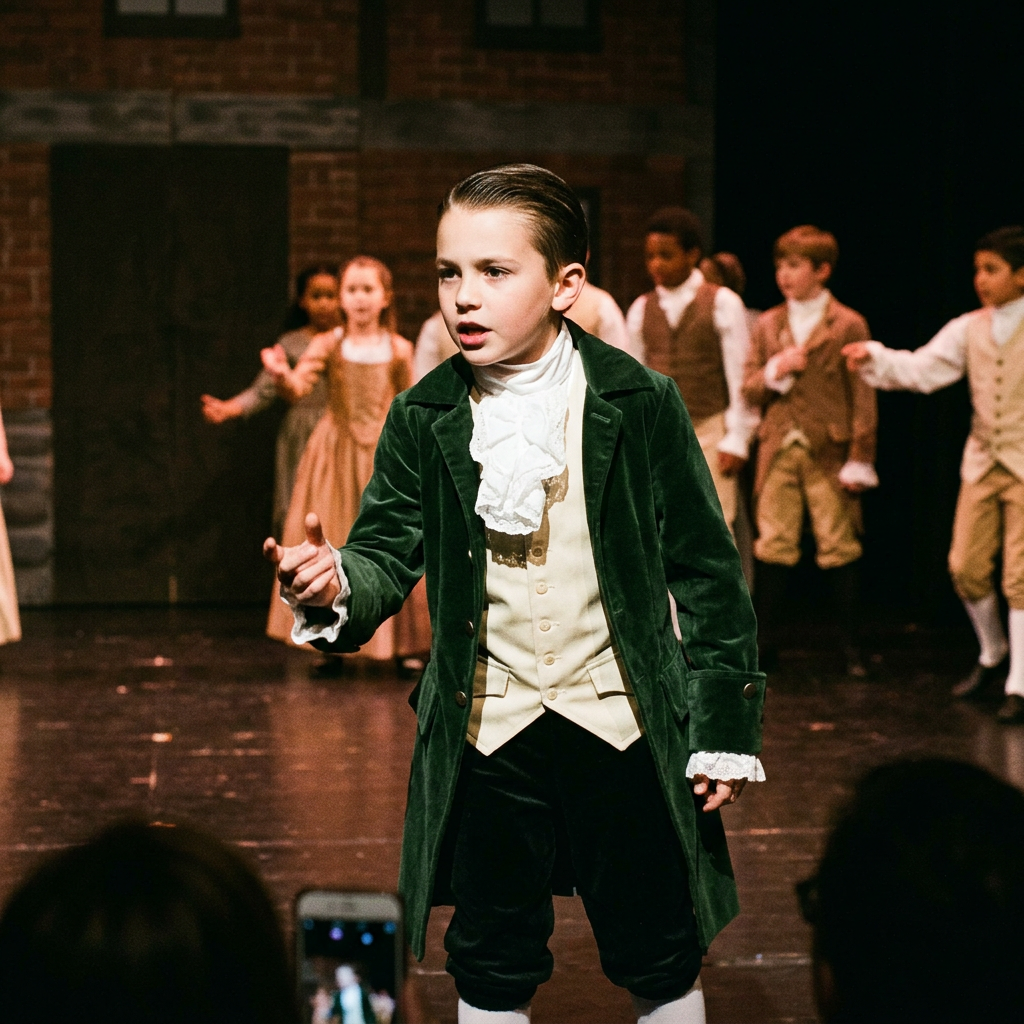
A dark coat in black or deep charcoal, well-fitted and clean-lined without any of the decorative trim or embellishment that marks the other characters' costumes. Burr's coat is deliberately understated, the visual equivalent of not showing your hand. Beneath it, a dark waistcoat in a slightly different shade of dark, so the costume has depth without brightness. A simple cravat in white or pale gray at the collar, the one concession to the period silhouette.
Bottom
Dark breeches or tailored trousers in charcoal or black, matching the coat closely enough that the whole silhouette reads as one composed, controlled unit. Burr should look like someone who made decisions about his appearance and then stopped thinking about it. The costume says: I have nothing to prove and nothing to show you. The visual restraint is the character.
Accessories
Minimal. A simple watch chain, a plain ring, one item of significance that he touches occasionally in moments of decision. Burr does not use props the way Hamilton uses his quill or George uses his crown. He moves through scenes without accumulating objects because accumulating objects would reveal preference and preference would reveal strategy. For the duel scene, a pistol prop that he holds with the deliberate care of someone who has been waiting to use it and is not sure he wants to.
Shoes
Dark boots or dress shoes in black or dark brown, clean and unobtrusive. Burr moves quietly and his shoes should support that quality. Nothing with a hard heel that announces his arrival. He appears in scenes before the other characters notice he is there, and his footwear is part of how he achieves that. Flat or very low-heeled, with a sole that allows silent, controlled movement across the stage floor.
Hair
Dark hair in a controlled, period-appropriate style. A low ponytail or a neatly pulled-back arrangement that keeps every strand in place. Nothing about Burr's appearance should suggest disorder or spontaneity. The hair is part of the performance of control. Even at the end of the show, after the duel, his hair should still be in place. The world is destroyed and his hair is fine. That is the tragedy of Aaron Burr.
Special Details
Burr's costume should be the darkest on stage and should remain so across all his appearances. As the show progresses and Hamilton's warmth accumulates in his growing family and his achievements, Burr's darkness should become increasingly conspicuous. Consider subtle lighting design choices that keep Burr slightly in shadow even in well-lit ensemble scenes, reinforcing the sense that he is always watching from a slightly different vantage point than everyone else.
Movement Tips
-
Wait for It is Burr's defining number and the choreography must navigate the central tension of the song carefully. He is not expressing frustration. He is not breaking down. He is explaining himself, possibly for the first time, and the movement should feel like the first honest thing he has let himself do in the whole show. Start completely contained, barely moving, the voice doing all the work. Let the body open slowly as the song progresses: arms extending slightly further, the head lifting, the feet beginning to travel. By the final chorus, Burr should be fully committed to his own movement in a way the audience has not seen before. Then he closes again. He puts it all back. Because that is what Burr does. -
Burr shadows Hamilton throughout the show and his choreography in shared scenes should reflect that relationship. He is often where Hamilton just was, a few counts behind, arriving in the same space a moment later. When they move in the same direction, it looks like pursuit. When they face each other, the spatial tension is immediately readable. Give Burr specific blocking choices that keep him physically proximate to Hamilton without ever quite being in the same orbit. He circles. -
The Room Where It Happens is Burr's frustrated ambition becoming visible for the first time, and the choreography should mark it as a turn. He has been restrained for so long that when the restraint shifts, even slightly, it is dramatic. Build the number from his characteristic stillness through increasingly committed physical choices. Not wild or uncontrolled, Burr never loses control, but the investment becomes visible. He wants to be in the room. The audience needs to feel how much he wants it. -
The final duel scene is the culmination of everything Burr has been holding and the staging must carry the weight of the whole show. Whatever choreographic choices you make around the duel itself, Burr's physicality in the moments before should be the most contained we have ever seen him. He has made his decision. He is past the point of doubt or return. The stillness just before the shot should be absolute. Everything that happens after it should be irreversible.
Best for ages 13-18. Burr needs a dancer with strong contemporary skills and the rare ability to make stillness as compelling as movement. This is a role for your most mature and self-aware performer, someone who understands that serving the story sometimes means not doing the flashiest thing in the room. The emotional arc from cautious observer to reluctant antagonist requires genuine acting intelligence alongside the technical training. Look for a performer who can hold an audience's attention while standing completely still at the edge of a busy scene. That quality is not common and it is exactly what Burr requires.
Ready to sell tickets for your Hamilton recital?
Stage Stubs makes it simple to sell tickets online. Create your event, set your prices, and start selling in minutes.