
Hamilton Character Guide
Alexander Hamilton
Alexander Hamilton is the founding father at the center of everything, an immigrant from the Caribbean who arrives in New York with nothing but ambition and an uncontrollable need to write. He fights in the Revolutionary War, becomes the first Secretary of the Treasury, builds the financial system of a new country, and destroys his own life through a series of choices he cannot stop himself from making. He is brilliant, reckless, and always in motion.
Personality for Dance
Hamilton never stops moving. Even when he is still, something in him is working, calculating, reaching toward the next thing. His hip hop foundation gives him sharp isolations, precise rhythmic footwork, and the kind of grounded, forward-leaning energy that tells the audience he is always about to launch himself somewhere. His arms are constantly in motion, gesturing, writing, pointing, reaching outward as though the world is not quite big enough for what he is trying to say. The contrast between his frenetic energy and Burr's controlled stillness is the physical heartbeat of the show. Hamilton leans in. Hamilton steps forward. Hamilton always takes up more space than the room was expecting.
The Outfit
Top
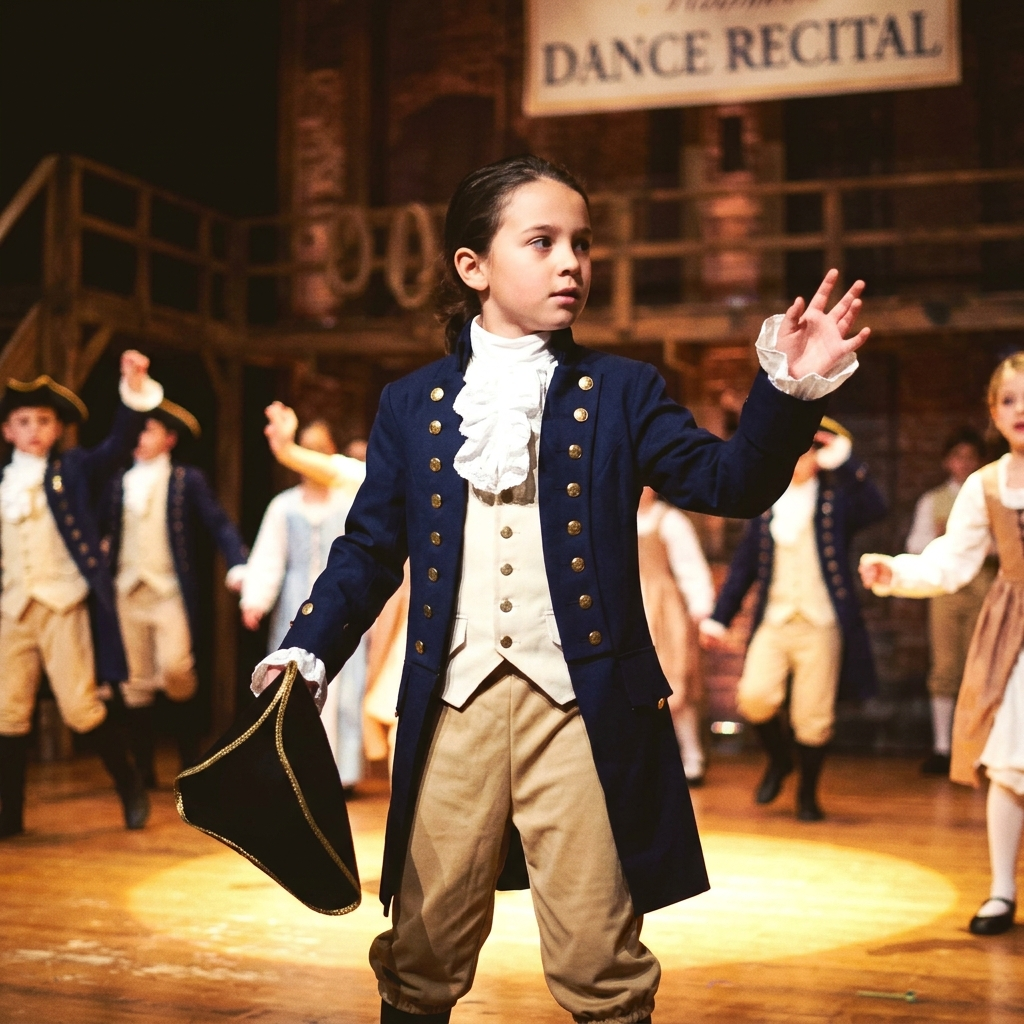
A white poet shirt with a wide collar and slightly billowed sleeves, tucked in at the waist. The shirt should be fitted enough through the torso to allow full movement while keeping the colonial silhouette. Over it, a fitted green or warm brown waistcoat with button detail or decorative trim along the front opening. The waistcoat is the most important piece because it defines his silhouette from the back row and reads as period-inspired without being a full costume that limits movement.
Bottom
Tan or warm brown breeches or tailored trousers that end just below the knee or at the ankle. If using full-length trousers, a slim or tapered cut keeps the colonial feel while allowing complete freedom for jumps, lunges, and floor work. Avoid loose or flared cuts that will read as modern rather than period. The trousers should be a shade that complements but does not match the waistcoat exactly.
Accessories
Hamilton's most important prop is a writing quill. A long white feather quill that he carries, tucks behind his ear, writes with in mime choreography, and points with during his most passionate arguments. It should be large enough to read from the back of a theater but light enough not to interfere with fast movement. A small leather-style pouch or satchel at his hip for transitions. A simple cravat or neckerchief at the collar completes the period look.
Shoes
Black or dark brown jazz shoes or low ankle boots with a simple buckle or strap detail. The shoes need to support all the hip hop footwork, the jumps, and the sustained floor contact of contemporary sections without slipping. Avoid hard-soled shoes that make excessive noise on a wooden stage floor during the quieter sections. A low heel or flat sole is best for the range of movement Hamilton requires.
Hair
Dark hair pulled back into a low ponytail tied with a simple black ribbon, suggesting the tied-back hairstyles of the Revolutionary era. If the performer has short hair, a small bun or slicked-back style with a ribbon works equally well. The hair must be completely secure for all the jumps and fast turns. Loose strands falling forward during intense sections work in character, but the base style should be intentional and tidy at the start.
Special Details
Consider a subtle sweat effect for My Shot and the battle sequences. Hamilton is always working at maximum effort and his costume should look like it by the end of an intense number. A slight dampening of the shirt at the collar and back helps sell the physical intensity without requiring a costume change. If multiple Hamilton performers are playing the role at different ages in ensemble sections, coordinate the waistcoat color and quill prop across all of them so the audience tracks the character clearly.
Movement Tips
-
My Shot is Hamilton's defining anthem and the choreography should build in three clear phases. Start with Hamilton alone at center, grounded and contained, the verse almost spoken rather than performed. As the ensemble enters, the movement opens up and the dynamic lifts. By the final chorus, every person on stage should be at full energy, arms wide, voices committed, occupying every corner of the space. The audience needs to feel the revolution beginning. Give Hamilton specific moments within the ensemble sections where he breaks free of the group formation and claims the center again. -
Writing choreography is one of the most distinctive physical ideas in the show and your Hamilton should make it specific and recognisable. Develop a consistent mime vocabulary for the act of writing: the quill dipped, the hand moving quickly across an invisible page, the pause to think, the frustrated crumple and discard. These gestures should appear in multiple numbers and become a signature. When Hamilton writes during a song, it tells the audience everything about who he is without a single word. -
The contrast between Hamilton and Burr is the show's central physical tension and should be visible in every scene they share. Hamilton leans forward. Burr leans back. Hamilton gestures outward. Burr keeps his hands contained. Hamilton takes up space. Burr creates a careful, measured amount of space around himself. When they move in sync, it should feel uncomfortable, like two magnets fighting their polarity. When they diverge, it should feel inevitable. -
Ensemble sections require Hamilton to be the spark that ignites everyone else. He is not leading the ensemble in the sense of being one count ahead. He is pulling them forward through sheer momentum. When he reaches out, they respond. When he turns, they turn. Choreograph moments where his impulse visibly travels through the group like a wave, so the audience sees his influence on the people around him even in the middle of a crowd.
Best for ages 12-17. Hamilton needs a performer with strong hip hop training who also has the acting intelligence to play someone brilliant, flawed, and perpetually three steps ahead of everyone in the room. Technical versatility matters enormously here because the choreography demands hip hop precision in My Shot, lyrical extension in quieter sections, and theatrical commitment throughout. The performer should be physically energetic and comfortable taking up space on stage. Younger dancers aged 10-11 can play Hamilton in simplified versions where the ensemble carries more of the choreographic complexity.
Ready to sell tickets for your Hamilton recital?
Stage Stubs makes it simple to sell tickets online. Create your event, set your prices, and start selling in minutes.