
Hamilton Character Guide
King George III
King George III is the British monarch who cannot understand why the American colonies would want to leave. He appears in a handful of scenes, each time becoming slightly more unhinged, singing cheerful pop songs about how devastated he is and how terribly the colonists will regret their decision. He is the show's comic relief in the most theatrical sense, a man of absolute power who responds to loss by becoming increasingly, gleefully unwell.
Personality for Dance
King George's power is in complete stillness. While the rest of the show is a blur of hip hop energy, Revolutionary War chaos, and political maneuvering, George enters and everything stops. He stands completely still at the centre of his own universe, composed and regal, and the contrast is instantly funny because the audience has been watching non-stop movement for half an hour. His comedy comes from tiny, perfectly timed details: a slow head turn, a single raised eyebrow, a finger pointed with devastating precision at no one in particular. When he does move, it is controlled and deliberate, the movement of someone who has never had to hurry for anything in his life. The key is to save the physical escalation for his later appearances, where the composure begins to crack in ways that are hilarious because they are so small.
The Outfit
Top
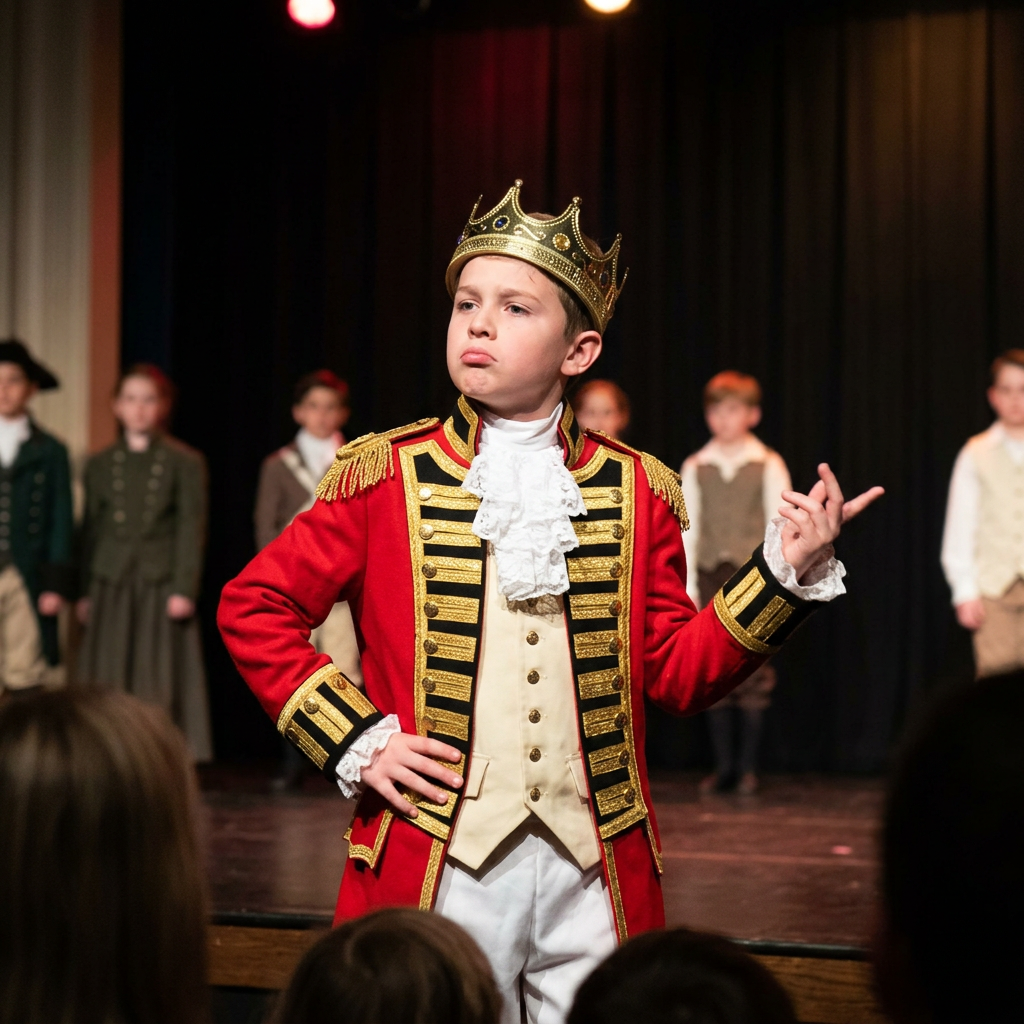
A regal red coat with gold trim at the cuffs, collar, and epaulettes. The coat should be fully structured and fitted, suggesting military formality while still allowing the range of movement the performer needs for his minimal but precise choreography. Gold buttons down the front. The red must be a strong, saturated scarlet that reads as power and authority from the back row. Beneath the coat, a white dress shirt with a high collar and a decorative cravat or stock tie in white or cream.
Bottom
White knee breeches in a clean, crisp white that contrasts sharply with the scarlet coat. The breeches should end just below the knee with a decorative buckle or button at the cuff. Below the breeches, white knee-high stockings pulled taut. The whole lower half of the costume should be immaculate, suggesting someone who has never bent down to pick something up off the floor in his life.
Accessories
A crown is non-negotiable. It can range from an elaborate reproduction crown with jewels and arches to a simple gold circlet, depending on your budget, but it must sit securely on the performer's head through all the carefully choreographed head movements. An ermine-trimmed cape or cloak for his first entrance, which he can remove and hand to an attendant as a staging moment. White gloves for the earlier scenes, which he peels off slowly as his composure begins to unravel in later appearances.
Shoes
Black or white buckled shoes with a small heel, the kind of formal footwear that suggests the eighteenth century without being so period-accurate that they become difficult to move in. The shoes should make a satisfying, authoritative sound on the stage floor when he does occasionally move. A small heel also gives the performer additional height, which reinforces the character's sense of physical elevation above everyone around him.
Hair
A white or powdered wig in the full, elaborate style of the period, with rolls at the temples and a queue at the back. The wig should be secured very firmly because George's head movements are among his most expressive physical tools and a shifting or falling wig will break the illusion. If a full wig is too unwieldy, a smaller version of the period style with the powder look achieved through product or a hairpiece can work equally well.
Special Details
George's costume should remain pristine and unchanged across all his appearances while the world around him descends into chaos and then rebuilds itself into a new country. His physical unchanging quality is part of the joke. He is exactly the same as he always was. Everyone else has had a revolution. He has not. If you stage a small court ensemble around him, dress them in matching red and gold so they form a visual unit that moves as one body when he commands and freezes when he is still.
Movement Tips
-
You'll Be Back is staged like a pop concert by a man who has never seen a pop concert but has been told what one looks like. George stands at what functions as a microphone stand, delivering his song to an audience of devastated courtiers and oblivious colonists. The movement should be minimal and knowingly theatrical: a slow walk to one side of the stage, a deliberate turn to address a different section of the audience, a single wave that is both regal and slightly unhinged. The comedy lives in his complete sincerity. He genuinely cannot imagine why you would not want to come back. Help him convey that. -
Stillness is the most important technical skill for this role. The performer must be able to hold a completely still position for extended periods while the ensemble moves around them, all without looking frozen or uncomfortable. Practice sustained stillness in rehearsal as a specific physical skill. The performer should be able to breathe, react with their eyes, and occasionally allow a tiny flicker of emotion to cross their face without the rest of their body moving at all. This is harder than it sounds and more rewarding when it is done well. -
King George's three appearances should escalate in precise, controlled increments. In his first appearance, he is fully composed and merely amused. In his second, there is a small but visible crack in the composure: a slightly too-long pause, a finger tapped on the thigh, a smile that does not quite reach the eyes. In his third, the unraveling is more visible but still controlled, the dignity is still there but it is working harder than it should have to. Build a specific movement or habit that escalates across all three appearances so the audience can track the progression. -
George's crown and cape are physical comedy tools as much as costume pieces. Choreograph his relationship with them deliberately. He adjusts the crown exactly once per appearance, always at the same moment, always with the same small gesture. He hands off the cape with the expectation of an attendant who may or may not be in the right place. These small interactions with the costume pieces give the performer comic moments to land and give the audience something to look forward to seeing again.
Best for ages 14-18. King George needs a performer with exceptional comic timing and the confidence to command an audience through minimal movement and absolute stillness. Technical dance skill matters less than stage presence and the ability to land a joke with a raised eyebrow. The role works beautifully for a performer who has strong musical theatre experience and is willing to commit fully to the theatrical artifice of the character. An adult performer can also play George with enormous success, particularly if the age contrast with the younger revolutionary characters reinforces the generational divide the show is exploring.
Ready to sell tickets for your Hamilton recital?
Stage Stubs makes it simple to sell tickets online. Create your event, set your prices, and start selling in minutes.