
Hamilton Character Guide
Lafayette / Jefferson
The same performer plays two completely different characters: the Marquis de Lafayette in Act 1 and Thomas Jefferson in Act 2. Lafayette is the French military ally who joins the American Revolution with reckless, exhilarating energy. Jefferson is the wealthy Virginia politician who returns from France to find a new country that is already arguing about everything. They share a performer but nothing else, and the audience should be genuinely surprised by how different the same person can look and move.
Personality for Dance
Lafayette exists in constant forward motion. His energy is breathless and infectious, his words tumbling out faster than most people can process them, his body always slightly ahead of where he means to be. He leans into sentences, he punctuates points with his whole torso, and he treats the stage like a race he is winning. Jefferson is the opposite. He saunters. He takes his time. He enters from wherever he has been, France or Monticello or somewhere fabulous, and he surveys the situation with the comfortable authority of a man who has never not been the smartest person in the room by several miles. Lafayette charges. Jefferson strolls. Both are completely certain they are right about everything.
The Outfit
Top
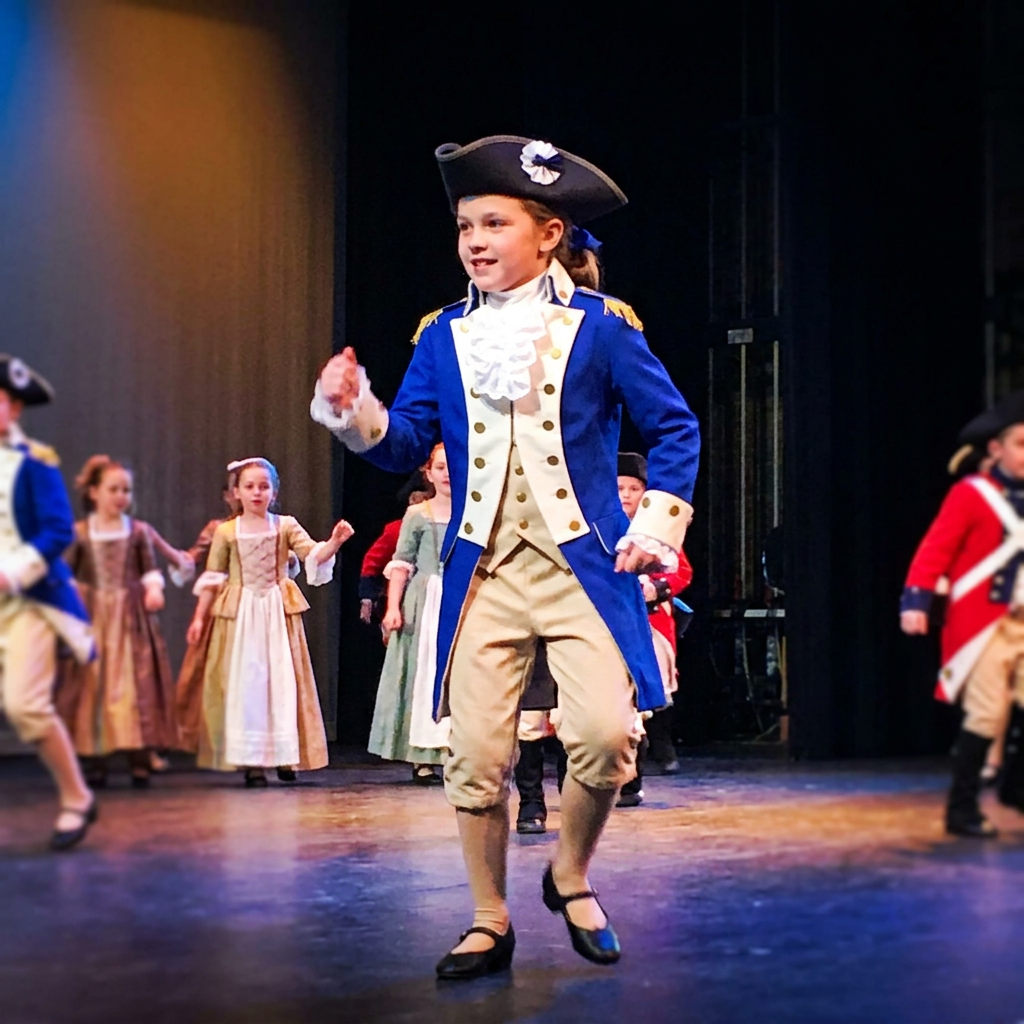
Act 1 Lafayette wears a blue French military coat with white lapels and gold epaulettes, the kind of coat that announces itself. It should be fitted and structured, with enough drama in the silhouette to read as both military authority and French panache. Act 2 Jefferson wears a purple velvet coat with ornate gold embroidery at the cuffs and collar, a richer and more flamboyant garment that suggests a man who has been living very well in Paris. The purple should be deep and saturated, a strong contrast to the revolutionary blues and greens of the other characters.
Bottom
Both characters wear white or cream breeches, providing a visual continuity between the two roles while the coat does the work of differentiation. The breeches should be clean and well-fitted for both characters. Lafayette's breeches can show some wear, a smudge of dirt at the knee suggesting someone who has actually been in a war. Jefferson's should be pristine.
Accessories
Lafayette wears a tricorn hat that he carries rather than wears for most of his scenes, using it as a prop to punctuate his gestures and then swinging it dramatically onto his head for key moments. Jefferson carries a walking cane that he swings rather than leans on, using it as a conductor's baton during What'd I Miss and a prop for his swagger. Both characters benefit from props that they can use expressively. The hat and cane should be established early and become signature items.
Shoes
Black boots with a small heel for both characters. The heel is important for both Lafayette's forward-driving momentum and Jefferson's swagger, giving the performer a slightly different physical relationship with the floor than the flat-soled characters around them. The boots should be sturdy enough for the intensity of Lafayette's choreography and polished enough to suit Jefferson's self-presentation.
Hair
A tricorn hat or wig change is the most efficient way to signal the transition between characters during the Act 1 to Act 2 shift. If using a wig, Lafayette has a dark, slightly disheveled ponytail suggesting someone who has been too busy fighting a war to worry about his appearance. Jefferson has a more elaborate style, powdered or styled with greater care. If the performer has their own hair, the quick-change relies on the coat and the movement quality to do the work of differentiation.
Special Details
The quick-change between Lafayette and Jefferson is a theatrical moment in itself and should be staged as one. Work out the logistics of the coat change and any hair or accessory adjustments so they can happen in ninety seconds or less in the wings. Brief the ensemble to cover the transition with choreography that occupies the audience's attention while the change happens. When Jefferson emerges, the movement quality should be so different from Lafayette that the audience registers the shift before they consciously process the costume change.
Movement Tips
-
Guns and Ships contains what is often cited as the fastest rap in the Broadway musical canon, and Lafayette's choreography needs to match the breathless speed of the text without becoming unintelligible physical noise. The key is contrast: between the fast sections and the brief moments of stillness that let the audience catch up. Give Lafayette one or two signature moves that repeat at the highest-energy moments so the audience has something to hold onto in the blur. Speed should feel exhilarating rather than chaotic. -
What'd I Miss is Jefferson's debut in Act 2 and the choreography should establish his character completely in the first thirty seconds. He enters from wherever he has been, surveys the scene, and finds it amusing that everyone is so stressed about things he has opinions on. Give him a long entrance walk with the cane, a slow turn to take in the space, and then a swagger into the centre that says he has been here before and he liked it better then. Everything about the staging tells the audience: this person is different from Lafayette. Same face, completely different creature. -
The quick-change moment between Lafayette and Jefferson can be staged as a theatrical event rather than hidden. If the set and staging allow for it, having the performer exit as Lafayette and re-enter almost immediately as Jefferson, with the audience able to see them acknowledge the shift, can be one of the most enjoyable moments in the show. Alternatively, a blackout change that the ensemble covers with a brief choreographic interlude keeps the pace up and rewards the audience when Jefferson appears. -
Lafayette in ensemble battle sequences should be the most physically present person in the frame after Hamilton himself. He is the character who makes the impossible seem achievable, and his movement should reflect that. Big jumps, wide spatial pathways, gestures that encompass the whole company. When Lafayette is on stage, everyone around him moves slightly more boldly. When Jefferson is on stage, everyone around him defers slightly more deliberately. The physical ecosystem around the performer should shift between acts.
Best for ages 14-18. This is a demanding dual role that requires a performer with both hip hop speed for Lafayette and jazz swagger for Jefferson, as well as the theatrical intelligence to make two characters feel completely distinct. The rapid-fire rapping in Guns and Ships requires specific technical preparation separate from the dance training, and the performer should begin working on the text very early in the rehearsal process. Look for someone who is physically confident and enjoys character transformation. The role is one of the most exciting in the show for the right performer.
Ready to sell tickets for your Hamilton recital?
Stage Stubs makes it simple to sell tickets online. Create your event, set your prices, and start selling in minutes.